Bali Travel Guide 2026: Tourist Levy, Visa, Top Sights, Food, Where to Stay and a 5–7 Day Itinerary

This Bali travel guide in one paragraph: plan 5–7 days, staying in Kuta, Seminyak or Jimbaran for beaches and in Ubud for culture and rice terraces. In 2026 most visitors need a visa on arrival (IDR 500,000, 30 days), a free All Indonesia arrival card filled in within 3 days before landing, and the Bali tourist levy of IDR 150,000 per person. Ubud's Sacred Monkey Forest costs IDR 130,000 for adults, and Mount Batur sunrise treks usually leave around 2 a.m.
Key takeaways
- The Bali tourist levy is IDR 150,000 per foreign visitor, paid once per trip, and can be paid in advance on the official Love Bali website.
- Many nationalities, including Taiwan, need a visa on arrival (VOA) or e-VOA: currently IDR 500,000 for 30 days, extendable once.
- The All Indonesia arrival card is free, combines immigration, customs and health declarations, and has been mandatory across Indonesia since October 2025.
- Ngurah Rai Airport is about 10–15 minutes from Kuta and 35–40 km from Ubud (about 1–1.5 hours, often over 2 hours in traffic).
- April–October is the dry season and November–March the wet season; on Nyepi (Day of Silence, around March) the airport closes for 24 hours.
What do you need for Bali in 2026? Visa, arrival card and tourist levy
For Bali in 2026 you need three separate things: a visa on arrival, the All Indonesia arrival card and the Bali tourist levy. Each is applied for separately, and only the arrival card is free.
| Item | Cost | Where | When |
|---|---|---|---|
| Visa on arrival (VOA / e-VOA) | IDR 500,000, 30-day stay | Indonesian immigration e-Visa site or on arrival at the airport | Apply for the e-VOA online before you fly |
| All Indonesia arrival card | Free | All Indonesia official site | Within 3 days before arrival |
| Bali tourist levy | IDR 150,000 | Love Bali official site, or payment counters at the airport and ports | Before you travel or on arrival |
Is the visa on arrival fee going up?
Indonesia's Directorate General of Immigration proposed new fees in August 2026: IDR 750,000 for an e-VOA obtained before departure and IDR 1,000,000 for a VOA issued on arrival. As of October 2026 no start date has been announced and the fee is still IDR 500,000, so check the official immigration site before you go.
How do you pay the Bali tourist levy?
The levy is charged under Bali Provincial Regulation No. 6 of 2023 (amended by Regulation No. 2 of 2025): IDR 150,000 per foreign visitor, paid only once per trip. Holders of a KITAS and some other residence permits are exempt.
- Go to the Love Bali website or app and choose single or group.
- Enter names, email, passport number, nationality and arrival date.
- Pay by card, bank transfer, virtual account or QRIS (no cash).
- A QR voucher is emailed to you; show it on arrival.
Only sites ending in baliprov.go.id are official, so avoid agents or drivers who offer to pay it for you at a mark-up.
What are Bali's rules for tourists in 2026?
Bali's Circular Letter No. 7 of 2025 (SE No. 7/2025) sets out a code of conduct for foreign visitors, and breaking it can mean being refused entry to sites, fines or even deportation. The key points:
- Non-worshippers may not enter the sacred inner areas of temples; dress modestly when visiting (most temples lend or rent sarongs).
- Don't climb sacred trees, statues or religious structures, and don't take indecent photos at religious sites.
- Single-use plastics (bags, styrofoam, straws) are banned, and so is littering.
- Use licensed guides and accommodation, change money at authorised outlets and follow traffic laws.
See the Bali provincial tourism office announcement.
What are the best things to do in Bali?
For a first trip, the places most worth your time are Ubud, Mount Batur, Uluwatu and the southern beaches. Check fees on site, as they change:
| Sight | Highlights | Cost | Time needed |
|---|---|---|---|
| Ubud (Sacred Monkey Forest, Tegallalang) | Cultural hub, art markets, rice terraces | Monkey Forest adults IDR 130,000 | 1–2 days |
| Mount Batur | Sunrise trek | Usually booked as a guided tour; prices vary | Half a day (pre-dawn start) |
| Uluwatu Temple | Clifftop sea temple, Kecak dance at dusk | Temple and Kecak tickets sold separately | 3–4 hours in the late afternoon |
| Kuta and Seminyak beaches | Surfing, sunsets, restaurants and bars | Free | Half a day |
Ubud: how to visit the Monkey Forest and rice terraces
Ubud is Bali's cultural centre, about 1–1.5 hours' drive from the airport. The Sacred Monkey Forest is open daily 9:00–18:00 (last entry 17:00), and its official site lists tickets at IDR 130,000 for adults and IDR 100,000 for children. The monkeys grab food and glasses, so keep belongings packed away.

The Tegallalang Rice Terraces north of Ubud. Photo: Philip Nalangan / Wikimedia Commons / CC BY 4.0
- The Tegallalang Rice Terraces are north of central Ubud; mornings have softer light and fewer people.
- Goa Gajah (Elephant Cave), Ubud Palace and Ubud Market are close to town and fit into one day.
- Ubud is full of yoga studios if you want a slower pace.
How long is the Mount Batur sunrise trek?
The Mount Batur (about 1,717 m) sunrise trek takes about 1.5–2 hours up and 4–5 hours round trip. Tours usually pick you up from your hotel at 1–2 a.m. to climb in the dark for sunrise, and in practice you must go with a guide registered with the local trekking association.

Sunrise from Mount Batur, with Lake Batur below. Photo: Aaron Rentfrew / Wikimedia Commons / CC BY-SA 4.0
It is cold at the top before dawn, so bring a warm layer, a headlamp and shoes with grip. If you'd rather not hike, 4WD jeep tours drive to a viewpoint instead.
Uluwatu Temple: clifftop sunsets and the Kecak dance
Uluwatu Temple sits on a cliff about 70 m above the sea at Bali's southern tip and is one of the island's key sea temples; the Kecak dance is performed in the open-air theatre next to it at about 18:00. Temple and Kecak tickets are sold separately, counters often take cash only, and prices are posted on site.

The cliffs of Uluwatu with Luhur Uluwatu Temple on top. Photo: Jakub Hałun / Wikimedia Commons / CC BY-SA 4.0
Monkeys live here too, so secure glasses, hats and phones. Kecak seats often sell out, so arrive about an hour early.
Kuta and Seminyak beaches
Kuta Beach is only about 10–15 minutes from the airport, with steady waves that suit beginner surfers; Seminyak to the north has more restaurants, beach clubs and boutiques. Both are known for sunsets, but evening traffic is heavy, so allow extra time.
What to eat in Bali
Bali's must-try dishes are babi guling (roast suckling pig), satay and the seafood barbecues on Jimbaran Beach.
| Dish | What it is | Where to try it |
|---|---|---|
| Babi guling | Spice-rubbed roast suckling pig with rice and spicy sides | Long-running warungs in Ubud and Denpasar |
| Satay (sate) | Chicken or pork skewers; Bali also has sate lilit made from minced fish | Night markets and street stalls |
| Jimbaran seafood barbecue | Grilled seafood on the sand at sunset | Jimbaran Beach restaurants |
Babi guling
Babi guling is Bali's signature dish: a whole suckling pig rubbed with turmeric, lemongrass, chilli and other spices, then spit-roasted until the skin crackles. It usually comes with rice, crispy skin, spiced minced meat and sambal. Because Bali is mainly Hindu, pork dishes are far more common here than elsewhere in Indonesia.
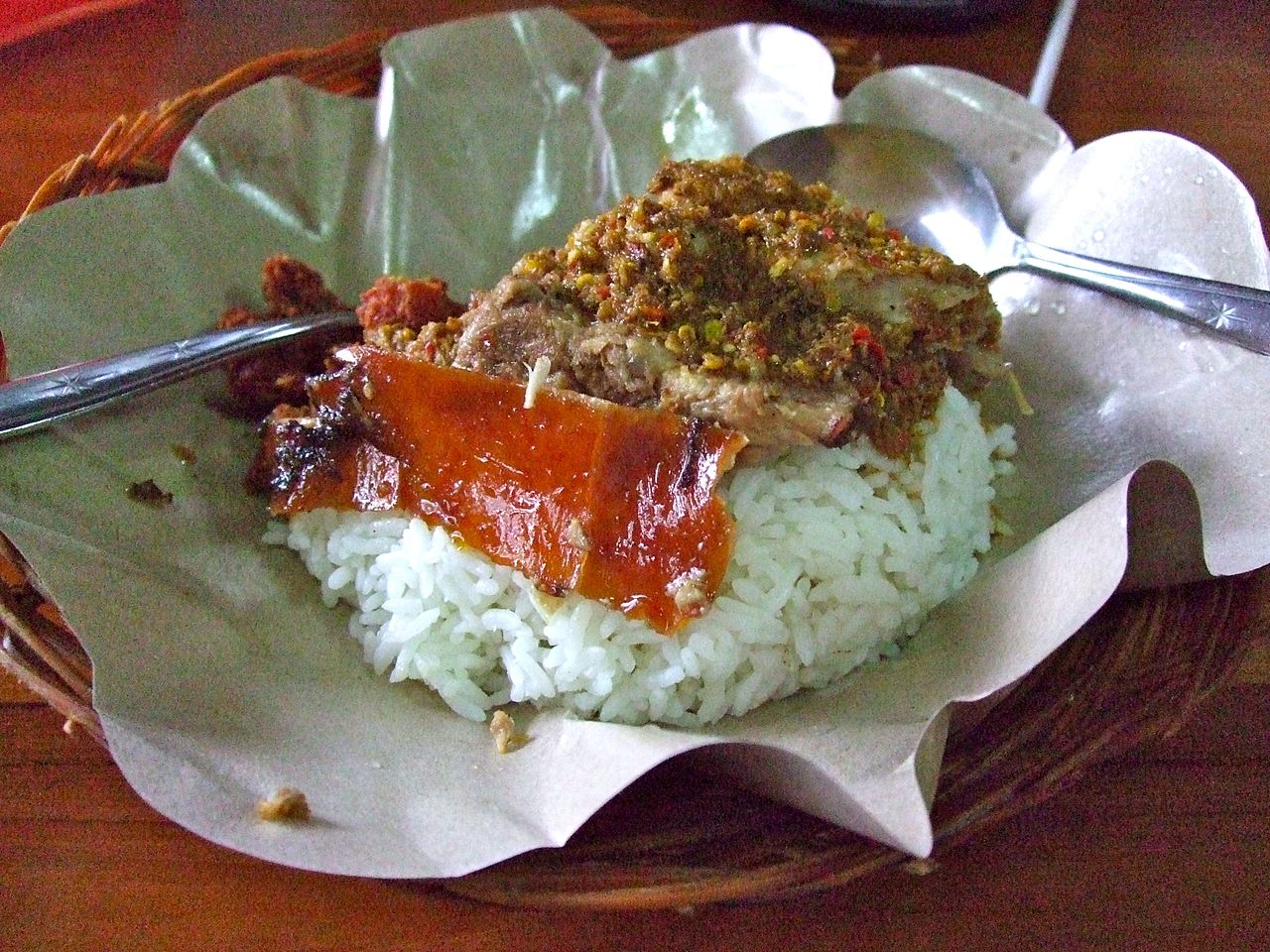
Nasi babi guling. Photo: WeI-chieh Chiu from Taipei, Taiwan / Wikimedia Commons / CC BY-SA 2.0
Satay (sate)
Satay is Indonesia's national skewer: chicken, pork or goat grilled over charcoal with peanut sauce or sweet soy. Bali's own sate lilit wraps minced fish or meat around lemongrass stalks before grilling, which gives it a stronger aroma.
Jimbaran seafood barbecue
In the late afternoon Jimbaran Beach fills with tables on the sand, where lobster, prawns and fish are grilled to order while the sun sets. Most places charge by weight, so confirm the price per kilo before ordering.

Jimbaran Beach at dusk with seafood restaurants on the sand. Photo: Akmaie Ajam / Wikimedia Commons / CC BY-SA 4.0
How many days in Bali? A 5–7 day itinerary
Five to seven days is ideal for Bali: start on the southern beaches and finish in Ubud to combine beach time with culture.
| Day | Plan | Stay |
|---|---|---|
| Day 1 | Arrive, sunset in Kuta or Seminyak | Southern beaches |
| Day 2 | Uluwatu Temple and the Kecak dance at dusk | Southern beaches |
| Day 3 | Jimbaran seafood dinner, move to Ubud | Ubud |
| Day 4 | Monkey Forest, Ubud Palace and market | Ubud |
| Day 5 | Pre-dawn Mount Batur sunrise trek, rice terraces in the afternoon | Ubud |
| Day 6 | Spa, yoga or shopping | Ubud or the south |
| Day 7 | Head to the airport | — |
Bali has no railway: you get around by private driver, taxi or ride-hailing apps, and the road from the south to Ubud is often jammed, so set aside half a day for the hotel change.
Where to stay in Bali
Bali's accommodation splits into the southern beach areas and Ubud in the centre; choose by what you want from the trip.
| Area | Best for | To the airport |
|---|---|---|
| Kuta | First-timers, tighter budgets, surfing | About 10–15 min |
| Seminyak | Restaurants, beach clubs, shopping | About 30–45 min |
| Jimbaran and Nusa Dua | Families, honeymoons, resorts | About 20–30 min |
| Ubud | Culture, rice terraces, yoga | About 1–1.5 hours |
Changing hotels in Bali with lots of luggage
With no railway, moving big suitcases around Bali means a car or taxi, and many lanes in Ubud and the beach areas are narrow; plenty of villas are reached by stone steps or paths through the rice fields. On a "beach first, then Ubud" trip, the half day between check-out and check-in often gets spent sitting in a car with your bags.
LuggAgent delivers luggage in Bali: we collect bags from the airport, the port or your hotel and deliver them the same day or the next day to your next hotel or the airport, so you can visit Uluwatu or the rice terraces hands-free. See Bali luggage delivery for coverage and prices.
If you're staying within 25 km of the airport, such as in Kuta, Seminyak or Jimbaran, you can hand us your bags at the airport as soon as you land:
If you're staying around Ubud or elsewhere 25–50 km from the airport, use this route, which also works for sending bags from your hotel back to the airport:
FAQ
Do I need a visa for Bali?
Most visitors do, including Taiwan passport holders. You can get a visa on arrival or apply online for an e-VOA before you fly: currently IDR 500,000 for 30 days, extendable once. Indonesia has proposed raising the e-VOA to IDR 750,000 and the on-arrival VOA to IDR 1,000,000, but as of October 2026 the change is not in force.
How much is the Bali tourist levy and how do I pay it?
It is IDR 150,000 per foreign visitor, paid once per trip. Pay in advance on the Love Bali website or app by card, transfer or QRIS, or cashless at the counters at Bali's airport and ports.
What is the All Indonesia arrival card and does it cost anything?
All Indonesia is Indonesia's online arrival card, combining immigration, customs and health declarations, and it is free. Fill it in within 3 days before arrival at allindonesia.imigrasi.go.id and show the QR code on arrival; every traveller, including children, needs their own.
What is the best time to visit Bali?
April–October, the dry season, has the most reliable weather, and July–August plus the year-end holidays are peak season with the highest prices. November–March is the wet season, usually with afternoon showers and lower prices. On Nyepi (around March, date varies with the Balinese calendar) the whole island shuts down and the airport closes for 24 hours.
How long does it take from Bali airport to Ubud?
Ngurah Rai Airport is about 35–40 km from Ubud: about 1–1.5 hours by car in light traffic, and over 2 hours in the afternoon and evening rush. There is no railway, so most people use a pre-booked driver, an airport taxi or a ride-hailing app.
How much is the Ubud Monkey Forest ticket?
According to its official site, IDR 130,000 for adults and IDR 100,000 for children; it is open daily 9:00–18:00 with last entry at 17:00. Feeding the monkeys is not allowed, so keep glasses, hats and food in your bag.
Cover photo: Chainwit. / Wikimedia Commons / CC BY 4.0
This article offers general travel tips for reference only. For actual services and conditions, please rely on the booking page and the latest official announcements.
Travelling light starts here.
Send your bags at the airport, your hotel or your homestay — we deliver them to your next destination.