Kyoto Autumn Leaves 2026: Arashiyama and Kiyomizu-dera Forecast, Plus Tokyo's Jingu Gaien Ginkgo Avenue

The best time to see Kyoto autumn leaves is usually mid-November to early December. The Japan Weather Association's tenki.jp forecast of October 1, 2026 expects Arashiyama to reach its best from about November 13, with eastern and western Japan "around normal or later than normal" this year. Kiyomizu-dera is typically at its best from late November to early December, and its 2026 autumn night opening runs November 21–30; Tokyo's Meiji Jingu Gaien ginkgo avenue turns gold from mid-November to early December.
Key takeaways
- tenki.jp's first 2026 autumn leaves forecast (October 1): Arashiyama in Kyoto from November 13, Mt. Takao in Tokyo from November 19.
- Kiyomizu-dera's 2026 autumn night opening runs November 21–30, open until 21:30 (last entry 21:00).
- Tenryu-ji's garden costs ¥500 for adults; from November 14 to 30, 2026 the Sogenchi Garden opens early at 7:30.
- The Meiji Jingu Gaien ginkgo avenue is usually best from mid-November to early December, a short walk from Aoyama-itchome subway station.
- Kyoto to Tokyo takes about 2 hours 15 minutes on the Nozomi Shinkansen; a reserved seat costs ¥14,170 in regular season.
When are Kyoto and Tokyo autumn leaves at their best in 2026?
Kyoto and Tokyo's autumn colours mostly peak from mid-November to early December, about a month later than Hokkaido and Tohoku. Here are each spot's usual peak and tenki.jp's forecast of October 1, 2026 (updated weekly; see the tenki.jp autumn leaves forecast for the latest):
| Spot | Type | Usual peak | 2026 forecast |
|---|---|---|---|
| Kyoto – Arashiyama | Maple | Mid-November to early December | From November 13 |
| Kyoto – Kiyomizu-dera | Maple | Late November to early December | Not published separately |
| Kyoto – Eikando | Maple | Mid- to late November | Not published separately |
| Tokyo – Meiji Jingu Gaien | Ginkgo | Mid-November to early December | Not published separately |
| Tokyo – Mt. Takao | Maple | Mid-November to early December | From November 19 |
tenki.jp forecasts Japanese maple (iroha-kaede) only, not ginkgo, and the actual timing depends on October–November temperatures, so check again a week before you go.
How to enjoy autumn leaves in Arashiyama: Togetsukyo Bridge, the Bamboo Grove and Tenryu-ji
Arashiyama is about 15 minutes from Kyoto Station on the JR Sagano Line to Saga-Arashiyama Station, and in autumn the best plan links Togetsukyo Bridge, the Bamboo Grove and Tenryu-ji into a half-day or full-day walk. Arashiyama usually peaks from mid-November to early December; for 2026 tenki.jp expects the best colour from November 13.

Togetsukyo Bridge and Arashiyama in autumn. Photo: くろふね / Wikimedia Commons / CC BY-SA 4.0
Recommended Arashiyama autumn route
- Walk from Saga-Arashiyama Station to Togetsukyo Bridge and take in the colours along the Katsura River.
- Head into the Sagano Bamboo Grove, where green bamboo meets red maples.
- Visit Tenryu-ji to see the autumn leaves reflected in the Sogenchi Garden pond.
- With more time, continue to Nison-in, Jojakko-ji and other temples of Oku-Saga, which are quieter than the main street.
Tenryu-ji admission and opening hours
Tenryu-ji is part of the "Historic Monuments of Ancient Kyoto" World Heritage Site, and its Sogenchi Garden is Arashiyama's most famous autumn spot. The garden costs ¥500 for high school students and adults and ¥300 for elementary and junior high students, plus ¥300 to enter the buildings; it's open 8:30–17:00 (last entry 16:50). From November 14 to 30, 2026 the Sogenchi Garden opens early at 7:30, so go first thing to beat the crowds.

Autumn colours at Tenryu-ji's Sogenchi Garden. Photo: Wikimedia Commons / Public domain
Kiyomizu-dera in autumn: night opening and nearby walks
Kiyomizu-dera is usually at its best from late November to early December, and its 2026 autumn night opening runs November 21–30 until 21:30 (last entry 21:00), with the wooden stage and maples lit up after dark. The temple opens at 6:00 and costs ¥500 for adults and ¥200 for students; see Kiyomizu-dera for the latest.
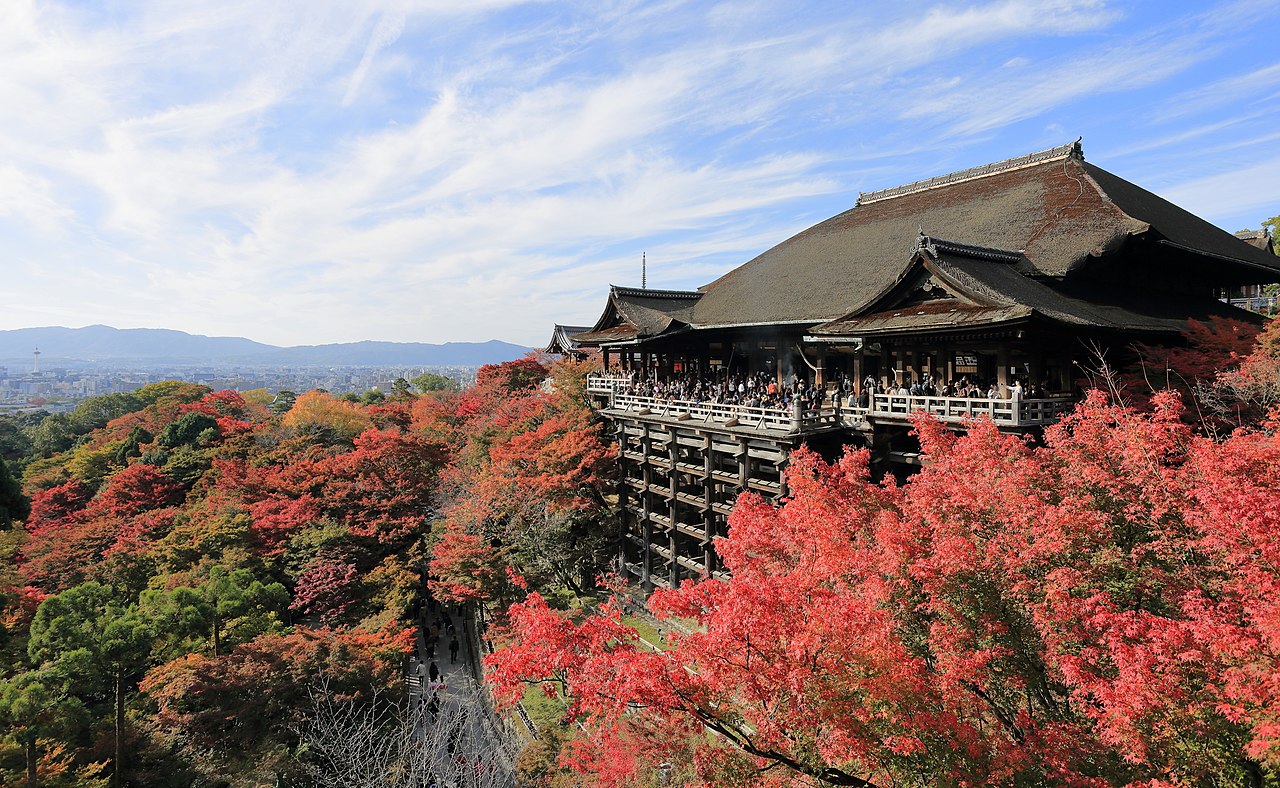
Kiyomizu-dera and its wooden stage in November. Photo: Martin Falbisoner / Wikimedia Commons / CC BY-SA 4.0
- From Kyoto Station take city bus 206 or 100 to Gojozaka, then walk about 10 minutes uphill.
- Right at the 6:00 opening the crowds are smallest, which is best for photos.
- Afterwards walk down Ninenzaka and Sannenzaka to Yasaka Shrine; the Higashiyama area fills half a day to a full day.
Meiji Jingu Gaien ginkgo avenue in Tokyo: how to get there and when to go
The Meiji Jingu Gaien ginkgo avenue usually turns gold from mid-November to early December, when two rows of tall ginkgo trees form a golden tunnel, Tokyo's best-known autumn sight. Gaien is in the Aoyama area of Minato City, a short walk from Aoyama-itchome Station on the Ginza, Hanzomon and Oedo subway lines; it's a different place from Meiji Jingu Shrine (the inner garden) in Harajuku, about 2 km away.

The Meiji Jingu Gaien ginkgo avenue in autumn. Photo: Kakidai / Wikimedia Commons / CC BY-SA 4.0
- Weekends are crowded, and weekday mornings are best for photos; roads around Gaien have traffic restrictions on Sundays and holidays.
- The Gaien area is being redeveloped and some sections may be fenced off; check Meiji Jingu Gaien for notices.
- After the ginkgo you can walk to Omotesando and Aoyama for shopping; for red maples, Rikugien is usually best from late November to mid-December.
Travelling with big luggage in autumn: Kyoto bus and Shinkansen rules
Kyoto's buses and sights are at their busiest in the autumn leaves season, and Kyoto City explicitly asks visitors not to bring large suitcases onto city buses. On the Tokaido Shinkansen, bags of 161–250 cm in total dimensions need a seat with an oversized-baggage area booked in advance, or you pay ¥1,000 on board. With autumn clothes, a camera and souvenirs, luggage is often the biggest hassle when changing cities.
The usual fixes are station lockers (often full in leaf season), leaving bags with your hotel, or a luggage delivery service that takes them straight to your next stop. LuggAgent collects at the airport arrivals hall or your hotel; choose a 09:00–11:00 pickup time when booking, leave bags at the hotel desk before then and they reach your next hotel or the airport by 21:00 the same day. See Kyoto luggage delivery for details.
If you want to head straight to Arashiyama or Kiyomizu-dera after landing at Kansai Airport, hand your bags over at the airport and we'll take them to your Kyoto hotel:
Moving on from Kyoto's maples to Tokyo's ginkgo, we can take your bags from your Kyoto hotel to Tokyo so you can ride the Shinkansen light:
On your departure day, your bags can go from your Tokyo hotel straight to Haneda Airport:
FAQ
When do Kyoto's autumn leaves peak in 2026?
Kyoto's leaves are usually best from mid-November to early December. tenki.jp's forecast of October 1, 2026 expects Arashiyama to peak from about November 13, with western Japan overall around normal or later; Kiyomizu-dera is usually best from late November to early December.
When is Kiyomizu-dera's autumn illumination in 2026?
Kiyomizu-dera's 2026 autumn night opening runs from November 21 to 30, open until 21:30 with last entry at 21:00. Admission is ¥500 for adults and ¥200 for elementary and junior high students.
When do the Meiji Jingu Gaien ginkgo trees turn yellow?
The Meiji Jingu Gaien ginkgo avenue is usually best from mid-November to early December; tenki.jp's forecast doesn't cover ginkgo, so check live reports before you go. It's a short walk from Aoyama-itchome subway station, and weekday mornings are less crowded than weekends.
How much does Tenryu-ji cost?
Tenryu-ji's garden costs ¥500 for high school students and adults and ¥300 for elementary and junior high students, plus ¥300 for the buildings and ¥500 for the Cloud Dragon painting in the Hatto. It's open 8:30–17:00, and the Sogenchi Garden opens at 7:30 from November 14 to 30, 2026.
Can I take a suitcase on the bus in Kyoto during leaf season?
Kyoto City asks visitors not to bring large suitcases onto city buses, and routes such as 100 and 206 are often full in leaf season. Use JR or the subway instead, or store or send your bags to your next hotel.
Cover photo: Martin Falbisoner / Wikimedia Commons / CC BY-SA 4.0
This article offers general travel tips for reference only. For actual services and conditions, please rely on the booking page and the latest official announcements.
Travelling light starts here.
Send your bags at the airport, your hotel or your homestay — we deliver them to your next destination.