What to Eat in Paris: Duck Breast, Escargots, Mussels, Macarons and Croissants (Where to Go and What It Costs)

The five classic things to eat in Paris are duck breast (magret de canard), Burgundy snails (escargots de Bourgogne), mussels in white wine (moules marinières), macarons and croissants. Budgets range from under €20 for a full meal at Bouillon Chartier, through about €40–60 a head at L'Escargot Montorgueil (open since 1832), to several hundred euros at three-Michelin-star Le Cinq. Mussels are in season from roughly June or July to February.
Key takeaways
- Le Cinq (Four Seasons Hotel George V) kept its three stars in the MICHELIN Guide France 2026; it serves dinner only, Tuesday to Saturday 19:00–22:00, and a jacket is required.
- L'Escargot Montorgueil has served Burgundy snails since 1832; the average à la carte spend is about €40–60.
- Bouillon Chartier is open every day 11:30–midnight, takes no reservations and promises a full meal for under €20.
- Du Pain et des Idées opens Monday to Friday 7:00–19:30 and closes at weekends; its signatures are the Pain des Amis and the chocolate-pistachio escargot pastry.
- Service is included in French restaurant prices, so tipping is optional.
What to eat in Paris: the 5 classics at a glance
These five dishes cover the core of the Paris bistro menu plus the two pastries most visitors come for. Here is what each one is and where to try it:
| Dish | French name | What it is | Where to try it |
|---|---|---|---|
| Duck breast | Magret de Canard | Crisp, rendered skin and pink meat, often with red wine or peppercorn sauce | Bistros; Le Cinq (fine dining) |
| Burgundy snails | Escargots de Bourgogne | Baked in garlic-parsley butter, served by the half-dozen or dozen | L'Escargot Montorgueil, Bouillon Chartier |
| Mussels in white wine | Moules Marinières | Steamed with white wine, shallots and herbs, usually with fries | Bistros and brasseries (in season) |
| Macarons | Macarons | Two almond meringue shells around a filling, crisp outside and soft inside | Pierre Hermé |
| Croissant | Croissant | Flaky, buttery layers; the Paris breakfast staple | Du Pain et des Idées and neighbourhood bakeries |
Best restaurants in Paris for classic French food, from budget to Michelin
Pick by budget: an old-school budget canteen, a classic bistro or a Michelin-starred dining room. All four below are still operating in 2026; budgets and hours are summarised here (always check the venue's own information):
| Restaurant | Type | Budget per person (excl. drinks) | Hours | Reservations |
|---|---|---|---|---|
| Bouillon Chartier (Grands Boulevards) | Budget historic canteen | Under about €20 | Daily 11:30–midnight | No reservations |
| L'Escargot Montorgueil | Snail specialist | About €40–60 | About 12:00–22:00 (sources vary) | Call ahead to check |
| Le Comptoir du Relais | Saint-Germain bistro | About €65 | Open daily | No reservations at lunch |
| Le Cinq | Three Michelin stars | À la carte mains about €175–280 | Tue–Sat 19:00–22:00 | Book well ahead |
Bouillon Chartier: a full meal for under €20
Bouillon Chartier was founded by the Chartier brothers in 1896 and still runs on the same idea: cheap, no reservations, continuous service. Starters begin at €1 and mains at about €7. The original Grands Boulevards dining room is at 7 rue du Faubourg Montmartre (9th), with branches at Montparnasse and Gare de l'Est. Queues build at peak times, so avoid arriving around 12:30 or 19:30.
Le Comptoir du Relais: a classic Saint-Germain bistro
Le Comptoir du Relais sits on the ground floor of the Hôtel Relais Saint-Germain at 9 Carrefour de l'Odéon (6th). Chef Yves Camdeborde opened it in 2004, and chef Bruno Doucet has run it since 2022. The menu sticks to bistro classics such as onion soup, croque-monsieur and seasonal meat dishes. It is open every day, and lunch is walk-in only, so expect to queue.
Le Cinq: three-star French fine dining
Le Cinq is inside the Four Seasons Hotel George V (31 avenue George V, 8th). Under chef Christian Le Squer it kept three stars in the MICHELIN Guide France 2026, its tenth year in a row. It serves dinner only (Tuesday to Saturday, 19:00–22:00), a jacket is required, and the menu changes with the seasons, so ask when booking if you want a particular dish.
Duck breast (magret de canard): how to order it
Duck breast is one of the most common mains on Paris bistro menus; order it medium (à point) or medium-rare (saignant) for the most tender result. Magret is the breast of a duck raised for foie gras, so it carries a thick layer of fat; cooks sear it skin-side down over low heat to render the fat and crisp the skin.

Duck breast with green peppercorn sauce. Photo: Arnaud 25 / Wikimedia Commons / CC BY-SA 4.0
- Typical sauces: red wine, green peppercorn, orange or honey.
- Typical sides: pommes sarladaises (potatoes fried in duck fat), green beans or salad.
- If you don't want it pink, ask for "bien cuit" (well done), but the meat will be drier.
Escargots de Bourgogne: where to eat snails in Paris
For classic Burgundy snails, the reference address is L'Escargot Montorgueil (38 rue Montorgueil, 1st), open since 1832; on a tighter budget, order them as a starter at Bouillon Chartier. The dish comes from Burgundy in eastern France: the snails are cooked, taken out of their shells, then packed back in with butter blended with garlic and parsley and baked.
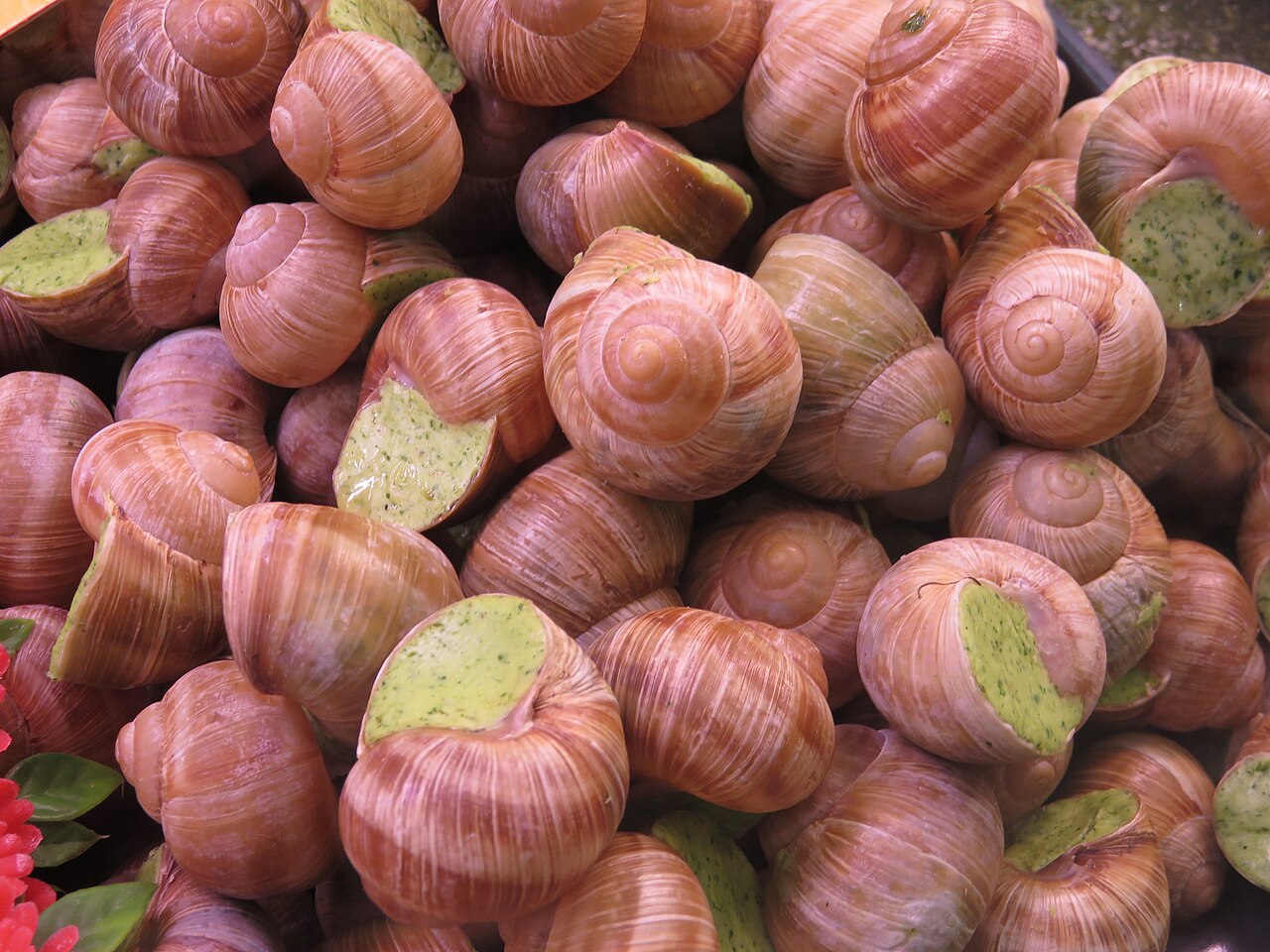
Burgundy snails filled with herb butter. Photo: Arnaud 25 / Wikimedia Commons / CC BY-SA 4.0
- L'Escargot Montorgueil's building and Second Empire interior are a listed historic monument, and the snails come in several recipes.
- How to eat them: grip the shell with the tongs, pull the snail out with the little fork, then mop up the leftover butter with bread.
- Portions are usually 6 or 12; six is plenty as a starter.
Moules marinières: when is mussel season in France?
Mussels are best from roughly June or July to February, when France's rope-grown mussels (moules de bouchot) from the Atlantic and Channel coasts are on sale. Mussels from the Bay of Mont-Saint-Michel (Moules de bouchot de la baie du Mont-Saint-Michel) carry a protected AOP label, and their sales start date is set each year after quality checks.

Moules marinières served in Paris. Photo: Maria Eklind / Wikimedia Commons / CC BY-SA 2.0
There are three common versions:
- Moules marinières: white wine, shallots and parsley; the classic.
- Moules à la crème: the white-wine broth finished with cream, richer.
- Moules à la provençale: with tomato, garlic and herbs.
In Paris, mussels usually appear on the seasonal menus of brasseries and bistros, served in a pot with fries (moules-frites).
Macarons: where to buy Pierre Hermé in Paris
Pierre Hermé is one of the best-known macaron houses in Paris, with several shops in the city; the ones visitors use most are 72 rue Bonaparte (6th, Saint-Germain) and 4 rue Cambon (1st). A macaron is two almond meringue shells around a ganache or jam filling, crisp outside and moist inside, and the house is best known for Ispahan, its rose, lychee and raspberry combination.

French macarons. Photo: Wikimedia Commons / Public domain
- The brand sells pick-your-own gift boxes in six sizes; check prices in store.
- Keep macarons refrigerated and eat them within a few days; check the best-before date if you plan to take them home.
Croissants: which Paris bakery is the most famous?
Almost every Paris street has a boulangerie, and Du Pain et des Idées is one of the most recommended. It is at 34 rue Yves Toudic (10th, near the Canal Saint-Martin) and opens Monday to Friday 7:00–19:30, closed at weekends. Christophe Vasseur opened it in 2002; besides croissants, its signatures are the large sharing loaf Pain des Amis and the chocolate-pistachio escargot pastry.

Croissants in a Paris bakery. Photo: Thomon / Wikimedia Commons / CC BY-SA 4.0
- For croissants fresh from the oven, go before 8–10 a.m.; popular items often sell out by the afternoon.
- Ask for a "croissant au beurre" for the all-butter version; a chocolate croissant is a "pain au chocolat".
How to handle luggage while eating your way around Paris
The usual problem comes on arrival or check-out day: you can't easily head straight to lunch with a large suitcase. Popular bistros are cramped, no-reservation places like Bouillon Chartier mean queuing, and many Paris metro stations have stairs but no lifts, which makes changing lines with a big case hard work. The usual fix is to drop bags at the hotel first, which costs you an extra round trip.
Another option is a luggage delivery service. LuggAgent collects bags from hotels and guesthouses in Paris, or from Charles de Gaulle and Orly airports, and delivers them to your next hotel or the airport; bags handed to the hotel front desk in the morning arrive the same evening. See the Paris luggage delivery page for details.
If you want to go straight into the city for your first meal after landing, hand your bags over at Charles de Gaulle and we deliver them to your hotel in Paris:
Arriving at Orly works the same way, with your bags delivered to your hotel in the city:
On the day you switch hotels in Paris, leave your bags at the front desk when you check out and spend the day at bakeries and lunch empty-handed:
FAQ
How much does a meal in Paris cost?
It varies a lot by type of restaurant: a budget canteen like Bouillon Chartier costs under about €20 for a full meal, a typical bistro about €30–65 a head, and Michelin-starred restaurants several hundred euros. Service is already included in French menu prices, so an extra tip is optional.
How do I book Le Cinq, and what are its opening hours?
Le Cinq serves dinner only, Tuesday to Saturday 19:00–22:00, and is closed Sunday and Monday; a jacket is required. Book several weeks ahead through the Four Seasons Hotel George V website, especially for weekend dinners.
Where can I eat escargots in Paris?
The classic choice is L'Escargot Montorgueil (38 rue Montorgueil), open since 1832, where the average à la carte spend is about €40–60. On a budget, Bouillon Chartier also has snails as a starter. Published opening hours vary between sources, so call before you go.
Is Du Pain et des Idées open at weekends?
No. Du Pain et des Idées opens Monday to Friday 7:00–19:30 and is closed on Saturday and Sunday, so plan a weekday visit. The popular chocolate-pistachio escargot pastry often sells out by the afternoon, so go in the morning.
When is the best season to eat mussels in Paris?
France's rope-grown mussels (moules de bouchot) go on sale from around June or July and stay in season until about February, so late summer to winter is when they are most common on menus. Bay of Mont-Saint-Michel mussels are an AOP product whose sales start date is set each year after quality checks.
Cover photo: Dietmar Rabich / Wikimedia Commons / CC BY-SA 4.0
This article offers general travel tips for reference only. For actual services and conditions, please rely on the booking page and the latest official announcements.
Travelling light starts here.
Send your bags at the airport, your hotel or your homestay — we deliver them to your next destination.